
How Montessori Can Build Executive Function Before Kindergarten
The prefrontal cortex is a fascinating and ever evolving part of the brain for our young students! Executive functioning includes many skills: working memory, impulse control, attention span, planning and organizing, emotional regulation, and more.
Here are some ways that a Montessori classroom can help build executive function for even our youngest learners.
Working memory
Working memory is an active “mental workspace” for using information while performing tasks, such as following multi step directions or solving a problem.
Montessori classrooms strengthen working memory through practical, hands-on experiences. These occur naturally throughout the day as students complete tasks, participate in work cycle, and use materials in a specific order.
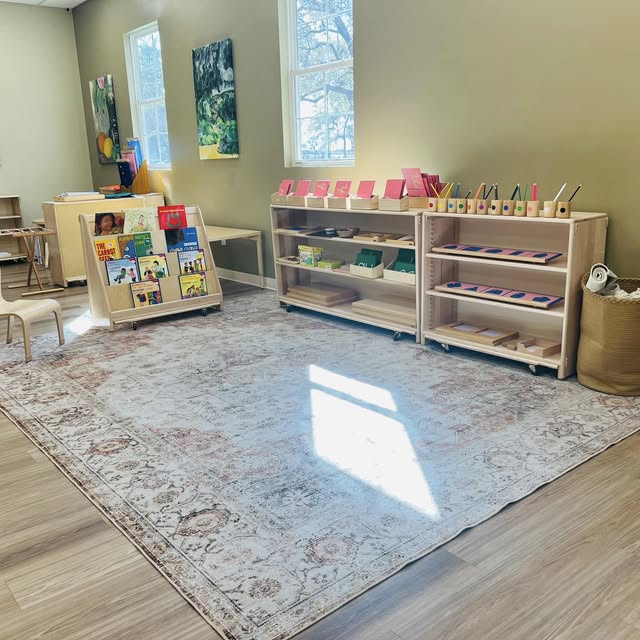
A prepared environment reduces mental clutter, letting students dedicate their cognitive energy to learning and memory. All items in the Montessori classroom are placed and ordered with purpose, setting children up for success by having a place for everything.
Sequential tasks such as table washing require children to remember and execute steps in a specific order, really exercising that pre frontal cortex!
Impulse Control and Emotional Regulation
Impulse control is a skill that can take a lifetime to master and it begins early on! Being given freedom within limits and the ability to make choices that are safe and appropriate, can reduce unsafe impulses that young children naturally have. A predictable and prepared environment creates this space for them.
Students also develop frustration tolerance because Montessori teachers do not jump in to take over the tasks that students are working on, unless they truly need assistance. Instead, they observe while the child works through the task at hand, allowing them to work through any frustrations they may have. This leads to the capability to emotionally regulate.
Attention Span
Controlled precise movements like with the metal insets and pouring work, require patience and care. They also require the child to have control of their movements and to be capable of slowing down when necessary.
A 2-3 hour uninterrupted work cycle gives children the opportunity to focus deeply, helping them build neural patterns without frequent distractions, thus leading to longer attention spans.
Planning and Organizing
Your toddler may not plan and execute the next holiday gathering for the whole family, but they will be able to plan and organize their thoughts and step by step directions! This planning is integral to completing tasks such as the spindle box, cleaning a table, or even building with blocks.
With all of these skills (and more), your child’s first day of Kindergarten will be a seamless transition. Over the years, our schools have received feedback from Kindergarten teachers about how impressed they are with the students coming into their classrooms. They show respect, responsibility, and an eagerness to learn.
Check out an MKU near you to set up a tour and see the magic of it all firsthand!